
A fellowship designed to close Africa’s health innovation gap is already reshaping how young scientists think – and act – beyond the lab.
In 2023, more than 150 infectious disease outbreaks were recorded across Africa. The continent still imports most of the vaccines, diagnostics and therapeutics it consumes, and the scientific talent able to change that picture remains scarce on the ground. The African STARS Fellowship Programme, launched by the Mastercard Foundation in partnership with the Centre for Epidemic Response and Innovation (CERI) at Stellenbosch University and the Center for Africa’s Resilience to Epidemics (CARE) at Institut Pasteur de Dakar, was designed to change that.
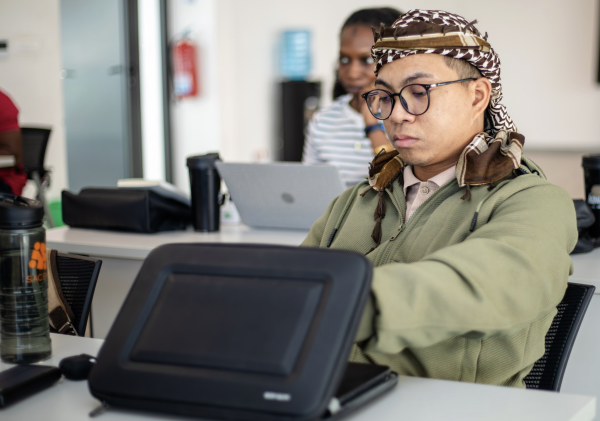
Levi Hosea joined the fellowship’s Young Professional Programme (YPP) from Madagascar. He arrived in Dakar with a strong profile: management of a public health programme inside a global project, plus consulting work across research, business development and data science. What drew him to African STARS was the piece of the problem his previous roles had not yet equipped him to solve.
“I had an idea of making access to care fun, easy and affordable. I was wondering how I could get appropriate guidance on how to make my idea real. One of the ASTARS offerings responds to this desire of growth and achievement.”
Levi first saw the call for applications on social media, then received direct messages from contacts in his network urging him to apply. He describes the fellowship as arriving at the right time, as he was actively looking for a structured way to deepen his understanding of the entrepreneurship side of public health, genomics and translational science.
The fellowship opens with four months of intensive training on health technologies, science and entrepreneurship, before fellows are placed inside IPD departments aligned with their career plans and capstone projects. Levi is candid that even a strong starting profile did not prepare him for the intensity.
“The fellowship is not like what I expected. Even from a strong science and business background, I didn’t expect the training to be highly challenging. The rigour and quality of trainings are really impressive and hard enough to prepare better, future global health and business leaders.”
That discomfort, he argues, is the point. Placement pushes fellows directly into what he calls the “first line of exploration, scientific rigor and responsibilities.” His days at IPD mix climate–health modelling for early warning systems, business intelligence and solutions development with personalised mentorship on his capstone project. New ideas, he notes, are not merely tolerated; they are requested.
“Exploration has a cost. But exploration is always welcomed and requested. This philosophy touched me profoundly as it puts growth and innovation at first priorities.”
Ask Levi what he will carry out of the fellowship and he does not describe a technique or a credential. He describes a reframing of the problem itself.
“Global health challenges can be resolved if scientific knowledge and innovations are translated into viable business. Science is the start, but business is the way. Scientific innovations which lack business implementation will fail.”
For Levi, IPD’s work on vaccines and diagnostics makes this concrete. A diagnostic test that stays in a laboratory cannot protect African populations. A vaccine that cannot recover its development costs cannot be sustained, let alone produced at the scale an outbreak demands. “The vaccines and diagnostics are put into market and should at least meet return on investment to be able to support more research and continue serving African populations.”
This is the systems change that African STARS is built around: ensuring that the next generation of African scientists does not stop at discovery, but is equipped to build, finance and lead the organisations that put those discoveries within reach of patients.
Levi’s capstone ambitions are practical. He is using the fellowship period to build relationships with people and businesses active in global health and technology, and to learn what it takes to start and invest in a healthtech company across Senegal and the wider West African market – a context that differs meaningfully from Madagascar’s. His stated goal is clear: a health tech startup assembled from both scientists and business operators.
He is equally candid about what the fellowship cannot do on its own. “It means for me that I have a lot of work ahead, including the set up of my health tech startup by gathering scientists and business. Global health challenges are, in big part, business challenges.”
When asked what he would say to someone considering the programme, Levi does not rely on the usual language of opportunity. “Applying for the ASTARS fellowship is a competition. Being an ASTARS fellow is still a competition. But here the competition is not among applicants and fellows. The competition is with you, and with global health challenges.”
Asked to describe the fellowship in a single phrase, his answer was short: Preparation for bigger responsibility. At CARE, we believe that African health sovereignty is not only a scientific question. It is also an entrepreneurial, institutional and financial one. Fellows like Levi are the reason we work on all four at the same time.
text & photo: Center for Africa’s Resilience to Epidemics (CARE) at the Institut Pasteur de Dakar